Add Row
Add Element
UPDATE
Add Element
  • Home
  • Categories
    • Business Marketing Tips
    • AI Marketing
    • Content Marketing
    • Reputation Marketing
    • Mobile Apps For Your Business
    • Marketing Trends
September 10.2025
3 Minutes Read

Unleash Creativity with Nano Banana: 15 Image Prompts to Try

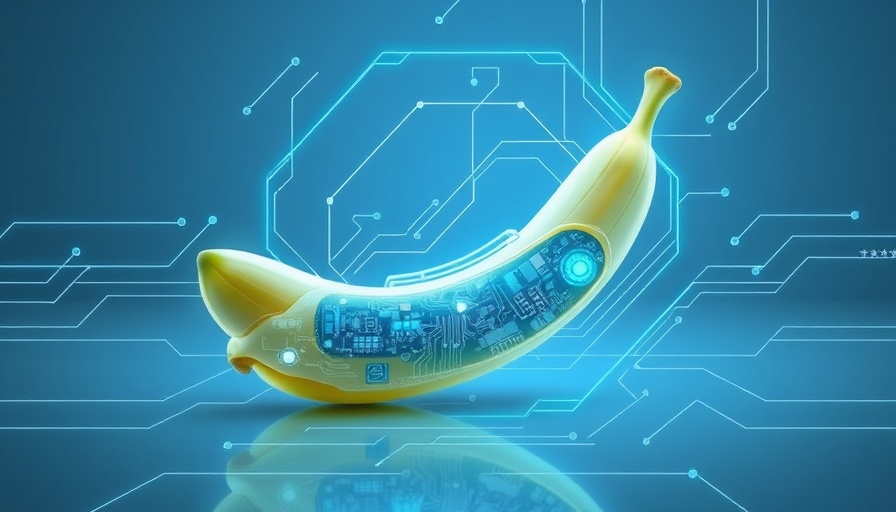
Futuristic banana with circuits in a tech-themed design, Nano Banana Prompts.

Exploring Nano Banana: Google’s New Creative Companion

In the constantly evolving world of artificial intelligence, Google’s latest image generation model, Nano Banana, has taken the online community by storm. It’s no surprise that small and medium-sized businesses (SMBs) are eager to harness this tool, given its stunning outputs that redefine image creation and editing. With just a thoughtful prompt about a person or place, Nano Banana yields magical results that can enhance any marketing strategy. Here’s a deeper dive into what makes this AI tool a game-changer and how SMBs can utilize it effectively.

What Makes Nano Banana Stand Out?

The advent of generative AI models has transformed the way businesses approach design and marketing. With Nano Banana, the process becomes not just easier but also creatively satisfying. This model is capable of generating high-quality images and enhancing them through editing, helping SMBs compete on a larger scale without the need for extensive resources.

10 Creative Prompts to Jumpstart Your Nano Banana Experience

Ready to explore the full capacity of Nano Banana? Try out these 10 prompts tailored specifically for image generation:

  • Task 1: Generating Realistic Images - Think of a scenario you want to illustrate and let the model construct a believable image.
  • Task 2: Sequential Art (Comic Panel / Storyboard) - Craft a comic strip or storyboard for product launches to visualize the customer journey.
  • Task 3: Stylized Illustrations & Stickers - Create unique visuals that portray your brand’s personality for social media and marketing materials.
  • Task 4: Add Accurate Text - Perfect for generating infographics, Nano Banana can help in adding informative captions or commentaries to your visuals.
  • Task 5: Product Mockups - Quickly generate stunning product mockups to attract potential customers before the actual product launch.
  • Task 6: Sketch to Image - Upload sketches to visualize concepts seamlessly—ideal for designers and marketers.
  • Task 7: Try an Outfit - Generate images of models wearing specific outfits—perfect for promotional campaigns in fashion retail.
  • Task 8: Create Multiple Poses - Showcase products from different angles or perspectives without needing extensive photo shoots.
  • Task 9: Ingredients to Dish - Combine images of raw ingredients to visualize final dishes for food-related businesses.
  • Task 10: Location to Architecture - Ideal for real estate marketing, visualize a property’s potential by generating images of the building in the desired location.

5 Additional Prompts for Image Editing with Nano Banana

But the capabilities don't end with creation! Here are five additional prompts to harness Nano Banana’s power in editing:

  • Task 1: Add/Remove Elements - Enhance your images by adding new features or removing distractions, essential for clarity in marketing imagery.
  • Task 2: Style Transfer - Give existing photos a new lease on life by applying art styles from famous artists.
  • Task 3: Color Correction - Elevate your visuals ensuring they match your brand's color palette perfectly.
  • Task 4: Image Resizing - Adapt images effortlessly to fit various platforms, crucial for maintaining consistency across social media.
  • Task 5: Add Text Effects - Use stunning typography to enhance the message of your visuals, making them more engaging for viewers.

Why Nano Banana is Essential for SMBs Today

With the digital landscape evolving faster than ever, small and medium businesses need to adopt innovative tools like Nano Banana to compete effectively. The ability to produce aesthetic visuals on-demand fosters a creative freedom that can distinguish brands in crowded marketplaces. This not only enhances customer engagement but also helps in reducing costs related to traditional photography and design.

Unlocking the Future: Predictions on AI Tools in Marketing

As we look to the future, the integration of AI tools like Nano Banana in the marketing realm will likely continue to grow. Businesses that embrace these technologies early can expect increased efficiency and the potential for greater customer connection through personalized content. Predictions suggest than in just a few years, practices that once required entire design teams may only need one efficient operator with advanced AI assistance.

Bring Your Business to Life with Nano Banana Today!

In conclusion, if you’re a small or medium-sized business owner looking to innovate and elevate your marketing efforts, experimenting with Nano Banana can be a significant step forward. By leveraging these prompts, you can create compelling visuals that resonate deeply with your target audience. With the right approach and thoughtful execution, you can unleash the full potential of this powerful AI tool. So why wait? Dive into the world of Nano Banana and witness the transformation it brings to your creativity and business growth!

AI Marketing

Write A Comment

*
*
Related Posts All Posts
01.26.2026

Discover How HEN Technologies is Creating an AI Gold Mine in Firefighting

Update Revolutionizing Firefighting: The Journey of Sunny SethiSunny Sethi, the founder of HEN Technologies, has pioneered a remarkable transformation in the firefighting sector, where technology often lags behind demand. With innovations that dramatically improve fire suppression capabilities while conserving vital resources, Sethi has captured the attention of tech-savvy businesses and emergency services alike.The Urgency of Advanced Firefighting TechnologyHistorically, firefighting equipment has remained relatively unchanged for decades, often relying on outdated methodologies. Yet, recent developments in wildfire intensity and frequency pose serious challenges—wildfires currently inflict devastating costs estimated between $400 billion to $800 billion annually in the U.S. alone. This context amplifies the significance of HEN Technologies' smart firefighting solutions.A Data-Driven Approach to FirefightingSethi's innovations extend beyond smarter nozzles. HEN Technologies, bolstered by a $22 million Series A funding round, is positioning itself as a leader in capturing operational data through intelligent fire suppression systems. Their innovative tools are not just hardware; they collect essential information about pressure, water flow, and firefighting efficiency that is crucial for developing predictive AI models. This data goldmine can radically change how fire departments respond to emergencies.From Hardware to a Predictive AI EcosystemWhat began with a simple, yet powerful nozzle has evolved into an entire ecosystem designed to predict and analyze firefighting effectiveness. HEN Technologies is creating a comprehensive dataset that helps build AI models capable of simulating real-world conditions—something current AI training methods cannot replicate.Strategic Customers and Future OpportunitiesWith their technology deployed in over 1,500 fire departments and generating projections of $20 million this year, HEN's growth is nothing short of impressive. Their products have caught the interest of elite customers, including NASA and military organizations, looking for cutting-edge firefighting solutions. The company's next steps will involve commercializing their predictive analytics platform, set to launch in 2027, further cementing their role at the intersection of firefighting and advanced technologies.A New Era for Emergency ResponseThe implications extend beyond just firefighting. The smart systems that HEN Technologies is developing can serve as critical infrastructure for emergency response, offering real-time data that could transform how cities plan for and manage emergencies, including natural disasters. Sethi’s vision isn’t just about better firefighting; it is about redefining the entire approach to emergency preparedness.Conclusion: Why This MattersHEN Technologies exemplifies how innovative thinking and cutting-edge technology can converge to meet urgent real-world needs. By transitioning from enhancing hardware to cultivating invaluable data, Sethi is laying the groundwork for a smarter, more efficient future in firefighting. For tech-savvy businesses ready to embrace this wave of change, HEN offers not just products, but solutions that could shape the future of safety in our communities.

01.25.2026

Unlocking the Secrets to Effective AI Collaboration in Businesses

Update Understanding the AI Collaboration Landscape In today's digital age, businesses are increasingly relying on artificial intelligence (AI) to enhance communication and improve operational efficiency. However, as enterprise collaboration tools become more sophisticated, a troubling trend emerges: the potential for orchestration failures. Imagine participating in a video call with several AI agents working behind the scenes, each performing specific tasks like transcription, speaker identification, and summarization. At first glance, everything appears to be functioning smoothly. But when we dig deeper, it becomes evident that these agents don’t always work together harmoniously. Spotting the Orchestration Gap According to user experience (UX) research, many users report frustration with AI collaboration tools, leading to stalled adoption rates. The metrics display green lights for individual agent performance—94% transcription accuracy and low response times—but this data fails to account for the user experience. Conflicting information between agents can lead to distrust, prompting users to abandon features altogether. This is a critical issue, especially as the adoption of task-specific AI agents in enterprise apps is projected to rise dramatically in the coming years. The Role of UX Research To truly understand these orchestration failures, traditional engineering dashboards fall short. It's evident that UX research methods must be adapted to capture the nuances of how these AI agents interact. For businesses, incorporating these insights can be a game-changer in developing products that genuinely meet user needs. Innovative UX Methods to Evaluate AI Agents Here are three effective UX research methods tailored to evaluate the orchestration of AI agents: 1. Think-Aloud Protocols for Agent Handoffs This method involves participants verbalizing their thoughts during specific moments of interaction with multiple AI agents. By asking users to vocalize their expectations and reactions, businesses can uncover areas where confusion and breakdowns occur, allowing them to pinpoint critical handoff errors. 2. Journey Mapping Across Agent Touchpoints Mapping out user journeys allows teams to visualize how different AI agents interact during key phases of collaboration. For example, if a user struggles at the handoff between a transcription agent and a summarization agent, the journey map will highlight that pain point, guiding necessary improvements. 3. Heuristic Evaluation for Agent Transparency An evaluation based on heuristic principles can help identify transparency issues within agent interactions. Businesses should assess whether users can easily understand what each agent is doing and whether they can trust the information presented to them. Case Study: The Implications for Enterprise Collaboration To illustrate the importance of orchestration in AI collaboration, consider the following scenario: a company uses AI tools during meetings to streamline summarization. Despite high individual accuracy rates, team members find themselves inundated with conflicting messages from different agents. This leads to frustration and a decline in team productivity. Such cases are becoming increasingly common as the reliance on AI grows. Preparing for the Future of AI Collaboration The potential for conflict between AI agents is not just a present challenge but a future risk as more AI functionalities are introduced into enterprise applications. For organizations to scale effectively, they must prioritize understanding orchestration quality today, rather than reacting to failure later. Final Thoughts As small and medium-sized businesses navigate the complex landscape of AI tools, focusing on the user experience can make all the difference in achieving successful collaboration. By adapting UX research methodologies, companies can reveal hidden orchestration failures that traditional metrics miss, ultimately fostering an environment where teams can thrive. Now more than ever, it is essential for businesses to prioritize UX in the development of AI-powered tools. By doing so, they not only enhance user satisfaction but also ensure a more seamless integration of technology into the workforce.

01.25.2026

Decoding AI for SMBS: Machine Learning vs Deep Learning Essentials

Update Understanding the Basics: Machine Learning vs. Deep Learning As businesses integrate artificial intelligence (AI) into their operations, distinguishing between Machine Learning (ML) and Deep Learning (DL) can be essential for strategic decision-making, especially for small and medium-sized businesses looking to leverage these technologies for growth. While both ML and DL analyze data and improve predictive accuracy over time, they differ significantly in their approaches and applications. What is Machine Learning? Machine Learning serves as the backbone of AI, processing data to identify patterns and make predictions without explicit programming for every decision. Typically, ML can be classified into three main types: Supervised Learning: Uses labeled datasets to train models, such as loan approval predictions based on applicant information. Unsupervised Learning: Identifies hidden patterns in unlabeled data, like segmenting customers by purchasing behavior. Reinforcement Learning: Learns through trial and error, receiving feedback for actions taken, ideal for tasks like game playing or control systems. Businesses frequently use ML in applications like recommendation systems, fraud detection, and customer insights, thus improving operational efficiency. Deep Learning: A Step Beyond Deep Learning, a subset of Machine Learning, utilizes complex artificial neural networks with many layers to mimic human brain processes. This allows DL to excel in tasks involving high-dimensional data such as images, speech, and text. Unlike traditional ML, which often requires feature selection by data scientists, DL automatically identifies the most relevant features, enabling faster and more accurate decision-making. However, deploying Deep Learning comes with challenges. It demands significant amounts of data and computational resources, making it less accessible for smaller organizations unless they invest in the right infrastructure or cloud solutions. Key Differences Between ML and DL Understanding the differences between these two technologies can help businesses make informed decisions: Complexity: ML is simpler and quicker to implement compared to the resource-intensive DL. Data Requirements: ML can operate effectively with smaller datasets, while DL typically needs vast amounts of data to perform well. Interpretability: ML models are generally easier to interpret, which is crucial for businesses that require transparency in decision-making. Application Scope: ML is suitable for structured data applications, while DL excels with unstructured data like images and sound. Applications of ML and DL in Business Both Machine Learning and Deep Learning have found applications across various industries, but their effectiveness varies by context. For example, ML is frequently used in: Finance: Fraud detection and risk assessment. E-commerce: Customer personalization and recommendation systems. Healthcare: Disease prediction and diagnostics based on historical data. Conversely, Deep Learning has significant impacts in fields like: Healthcare: Medical image analysis and genomics. Automotive: Autonomous driving systems relying on complex real-time data processing. Entertainment: Content creation and recommendation algorithms based on viewing habits. Why These Technologies Matter for Small and Medium Businesses For small and medium-sized businesses, leveraging ML and DL can enhance competitiveness. They provide tools for better data-driven decision-making, operational efficiency, and customer engagement. However, the key lies in understanding which technology fits their needs best. Businesses must weigh their data capabilities, resource availability, and long-term goals when deciding to integrate these technologies. Future Trends and Opportunities Looking ahead, the demand for AI solutions will continue to surge, with the AI market expected to grow significantly over the coming years. This rapid expansion presents immense opportunities for small businesses to capitalize on AI through: Enhanced Personalization: Leveraging ML to create tailored consumer experiences. Operational Automation: Utilizing DL to streamline complex processes and reduce operational costs. As AI becomes a foundational element of business strategy, prioritizing the integration of ML and DL tools will be crucial for sustained growth. Conclusion: Make Smart AI Investments Understanding the nuanced differences between Machine Learning and Deep Learning is paramount for small and medium-sized businesses looking to innovate and grow. By identifying specific pain points and opportunities within their operations, businesses can harness these technologies to gain a competitive edge. As you consider AI solutions, remember that choosing the right technology can transform your business strategy and operational capabilities. For guided assistance in integrating the latest AI technologies, reach out to industry experts to align your tools with your business needs.

Terms of Service

Privacy Policy

Core Modal Title

Sorry, no results found

You Might Find These Articles Interesting

T
Please Check Your Email
We Will Be Following Up Shortly
*
*
*