Add Row
Add Element
UPDATE
Add Element
  • Home
  • Categories
    • Business Marketing Tips
    • AI Marketing
    • Content Marketing
    • Reputation Marketing
    • Mobile Apps For Your Business
    • Marketing Trends
October 26.2025
3 Minutes Read

Empower Your Business with Beginner-Friendly Google Skills Courses

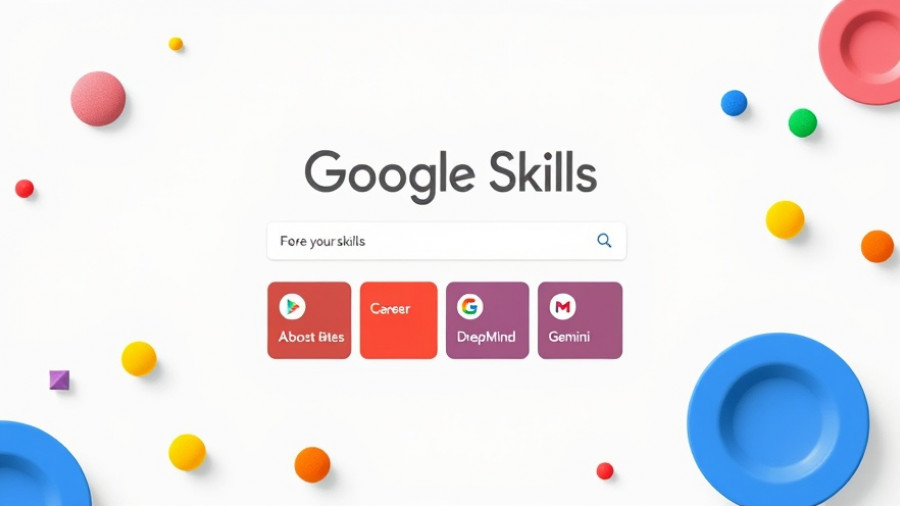
Beginner-friendly Google Skills courses homepage with colorful design.

Unlocking the Power of Google Skills for Business Growth

In today’s rapidly evolving job market, small and medium-sized businesses (SMBs) must stay ahead by embracing new technologies and skills. Google's initiative, Google Skills, is designed to empower individuals and organizations alike with essential skills that matter in real-world scenarios. With a wealth of beginner-friendly courses, Google Skills offers an accessible pathway to mastering tools that are critical in the tech landscape.

Why Google Skills Matter for SMBs

As businesses navigate the digital age, the need for specific competencies has never been higher. Google Skills provides quick access to skills that aren’t just theoretical but directly applicable in workplace environments. From data analytics to cloud services, these courses help employees upskill quickly, bridging the gap between novice and proficient practitioner.

Moreover, the Google Skill Badges signify a learner’s commitment to personal development, making them valuable assets during recruitment. Employers recognize these badges as indicators of practical knowledge and readiness, giving SMBs a competitive edge in hiring.

Top 5 Google Skills Courses Transforming Careers

For SMB owners and their employees eager to enhance their skill sets, here are five of the top Google Skills courses ideal for beginners:

  1. Derive Insights from BigQuery Data
    This course enables you to interact with and extract insights from complex data sets using SQL, significantly elevating your analytic capabilities.
  2. Share Data Using Google Data Cloud
    Learn how to harness the data-sharing tools available through Google Cloud, essential for any data-driven organization.
  3. Get Started with Google Workspace Tools
    This course covers the full suite of Google Workspace tools, providing fundamental skills necessary for modern collaboration.
  4. Migrate MySQL Data to Cloud SQL Using Database Migration Service
    If cloud data management intrigues you, this course guides you through essential migration processes.
  5. Monitor Environments with Google Cloud Managed Service for Prometheus
    This course is perfect for those wanting to understand how to monitor and maintain cloud environments effectively.

These courses are structured with hands-on experiences and realistic tasks, providing not just theoretical knowledge but valuable experience that can easily translate into the workplace.

How to Choose Your Learning Path

With such a variety of courses available, taking the first step can be overwhelming. Therefore, it is crucial to consider what skills you or your team are most interested in developing. Do you want to analyze data, enhance collaboration, or deploy cloud solutions? Select a course that aligns with these interests, and don't hesitate to stack multiple courses to create a customized learning pathway.

The Future of Work is Here

The shift towards digital and data-driven decision-making is upon us, and skills offered by Google Skills are fundamental for any modern workforce. As businesses increasingly rely on technology, investing in employee training not only boosts morale but also propels the business forward. The opportunities available today can't be overlooked—now is the time to take action.

Take Action with Google Skills

Are you ready to empower yourself and your team with in-demand skills? Start exploring the Google Skills courses today, and unlock the potential for career advancement and business growth. Equip yourself with knowledge that will help you thrive in an ever-changing job landscape.

AI Marketing

Write A Comment

*
*
Related Posts All Posts
12.15.2025

Discover GPT-5.2: Revolutionizing Task Management for SMBs

Update Understanding GPT-5.2's Evolution in AI Technology OpenAI has recently unveiled its most sophisticated artificial intelligence model to date: GPT-5.2. This new version shows significant enhancements over its predecessor, GPT-5.1, released just weeks prior. Primarily aimed at professional environments, GPT-5.2 is reshaping workflows in small and medium-sized businesses (SMBs), allowing tasks traditionally done by teams to be handled more efficiently by AI. The Major Upgrades in GPT-5.2 Among the standout features of GPT-5.2 are its capabilities in creating spreadsheets, building presentations, understanding visual content, and managing lengthy contexts of information. These improvements are not just theoretical; practical tests have shown tangible benefits. For instance, it can efficiently manage multi-step projects, aligning perfectly with the nuanced tasks faced by SMBs. Breaking Down Real-World Applications One of the most robust testing grounds for GPT-5.2's functionality is its performance in generating tasks related to professional workloads. According to OpenAI's evaluations, the model can confidently operate within parameters similar to human experts, making it an asset in industries like finance, healthcare, and professional services. Performance Metrics: How Does It Stack Up? When evaluated against industry benchmarks, GPT-5.2 excelled with an impressive performance rating of around 71% on the GDPval assessment—a significant leap from 40% for GPT-5. Its ability to complete tasks faster than human counterparts, often with higher success rates, demonstrates a potential game-changer for SMBs aiming to enhance productivity without exorbitant expenditures. In practical terms, this means faster project deliveries and increased efficiency. Considerations for Utilizing AI in Business Workflows While the benefits of integrating GPT-5.2 into daily business operations are evident, there are also important considerations. Managers must ensure that the introduction of such technology aligns with their overall strategic goals. The potential for AI-induced efficiencies must be balanced against the need for human oversight to maintain the quality of work. AI, while powerful, lacks the nuanced understanding that comes from human experience. The Future of AI in the SMB Landscape As AI continues to evolve, its integration into small and medium businesses is not just a trend—it’s becoming a necessity. GPT-5.2 is paving the way for enhanced operational capabilities, fostering growth, and enabling businesses to remain competitive in a fast-paced market. With AI-assisted functions becoming more accessible, the future looks promising for SMBs willing to adapt. Act Now: Integrate AI to Boost Your Business Businesses that take proactive steps to incorporate AI tools like GPT-5.2 will likely position themselves for success. Whether it’s streamlining project management or enhancing customer engagement, the benefits are clear. Ready to explore how GPT-5.2 can transform your workflow?

12.15.2025

Unlocking AI Potential: Build RAG Applications with AutoRAG

Update The Rising Demand for RAG Applications In today’s fast-paced digital landscape, businesses are constantly seeking innovative solutions to enhance their services and improve user engagement. As artificial intelligence (AI) continues to evolve, the concept of Retrieval-Augmented Generation (RAG) has gained prominence. RAG enables AI applications to provide more accurate and reliable responses by leveraging external data sources. With the increasing complexity of AI models, there is a growing need for tools that simplify the development of RAG applications. One such tool is AutoRAG, designed to facilitate the creation, evaluation, and optimization of RAG pipelines quickly and efficiently. Understanding Retrieval-Augmented Generation (RAG) Retrieval-Augmented Generation (RAG) combines AI-generated responses with information retrieved from external databases, ensuring the results are grounded in credible sources. This approach includes two primary components: the Retriever, which locates relevant information, and the Generator, which formulates a response based on the retrieved data. RAG applications are transformative, especially in domains such as customer service and knowledge management, helping businesses provide accurate answers to user inquiries through enhanced AI capabilities. Introduction to AutoRAG: Your New Development Ally AutoRAG aids developers in building RAG applications by automating the pipeline development process. It streamlines experimentation through robust configurations, allowing teams to test various retrieval methods and embedding strategies seamlessly. With AutoRAG, developers are empowered to explore multiple design choices without the complexities of manual coding. This capability is crucial for businesses looking to optimize their internal processes and deliver exceptional customer experiences. Key Components of a RAG Application Building a successful RAG application necessitates an understanding of its key components. The Retriever indexes documents and searches the database for relevant information. Next, the Embedding Model organizes the data based on semantic similarity. Finally, the Generator composes the final answer by interpreting the retrieved content based on context. Understanding these elements will aid businesses in effectively implementing RAG applications tailored to their specific needs. Steps to Build a RAG Application with AutoRAG Creating a RAG application using AutoRAG is broadly divided into several steps: Setting Up Your Environment: Developers need to establish a Python environment with specific dependencies to run AutoRAG successfully. Data Processing: This stage involves parsing documents and creating embeddings to store in a vector database. Experimentation: With AutoRAG, teams can experiment with different pipeline configurations and evaluate their performance using built-in metrics. Deployment: After testing and optimizing the pipeline, businesses can go live, using their RAG system to respond to customer queries effectively. Best Practices for Implementing RAG Applications To ensure the successful deployment of RAG applications, businesses should adhere to several best practices: Maintain original content alongside embeddings to ensure context integrity. Implement sensible chunking methodologies to preserve meaning in data processing. Monitor performance metrics consistently to refine the application's responses and accuracy. Secure sensitive configuration keys via environment variables instead of embedding them directly into the code. The Future of RAG with AutoRAG The potential applications of RAG are vast and ever-expanding. As businesses increasingly adopt AI to improve their services, tools like AutoRAG will play a pivotal role in simplifying the development of sophisticated AI solutions. With an emphasis on reliability and efficiency, RAG applications will not only enhance user interactions but also optimize business workflows, making them invaluable for small and medium-sized enterprises keen on leveraging AI technology to stay competitive. Call to Action: Explore AutoRAG for Your Business Needs If your business is looking to harness the power of AI with reliability, now is the time to explore the capabilities of AutoRAG. Begin your journey toward building innovative, data-driven applications that can transform your customer engagement and operational efficiency today.

12.15.2025

How AI Is Revolutionizing Your Brand Narrative Today

Update Understanding AI’s Role in Brand Narrative In an age where technology and communication are intertwined, the way brands connect with their audiences is being revolutionized by artificial intelligence (AI). The conventional understanding of a brand primarily revolved around what companies broadcast through advertisements and marketing campaigns. However, this understanding is evolving as brands increasingly find their narratives shaped not just by their own message but through AI interpretations of their online presence. Your Brand in the Age of AI Every time a consumer interacts with an AI system, such as ChatGPT or others, regarding a product or service, they are mining information from a host of online sources including articles, blogs, and user-generated content. These platforms form a composite understanding of your brand based on their analysis of data you might not be directly managing. This shift demands that businesses actively engage in managing their "algorithmic footprint." Without this, brands risk being portrayed inaccurately or unfavorably. The Evolution of Brand Management It's a wake-up call for small and medium-sized businesses (SMBs): if your current brand management strategy does not include considerations of AI's impact on your digital presence, you are already behind the curve. Myriam Jessier, a technical SEO expert, highlights that most brands lack real-time insights into their representation across AI search platforms. They rely on fragmented tools, which often leads to outdated understandings of their corporate image in real time. These inadequacies may hinder their ability to optimize brand perception before a consumer even enters the purchasing journey. Co-Creation of Brand Narrative with AI The emergence of AI indicates that branding is now a co-creative process, where your narrative doesn't stem solely from your company but also from customer input, online communities, and even AI training data. For instance, when AI identifies consistent mentions of a brand related to certain topics, it helps frame consumer perceptions and can position that brand as a trusted expert in its field. This is crucial as prospective customers often rely on AI’s guidance when they explore their options. Why Attention to AI Responses Matters Companies must recognize how AI-generated responses can influence brand perception. The implications are significant: brands consistently mentioned in AI-generated content often gain credibility that far surpasses traditional marketing materials. Therefore, ensuring you maintain a favorable algorithmic presence is key. The Importance of Narrative Accuracy Accuracy in communicating your brand narrative is paramount. AI helps ensure this accuracy by leveraging vast datasets, enabling brands to understand consumer sentiments and craft narratives that resonate more profoundly by utilizing frameworks from the data. The algorithmic insight AI provides allows businesses to detect gaps between their intended narratives and the narratives formed by AI. Unique Benefits of AI in Brand Storytelling Using AI to drive brand storytelling not only strengthens how businesses tell their stories but also effectively aligns messaging with consumer interests. By tailoring stories based on data-driven insights, brands can enhance engagement and trust amongst their audiences. This method enables brands to stand out in a crowded marketplace and form lasting connections. Implications for Small and Medium-Sized Businesses For SMBs, the integration of AI into marketing strategies presents both an opportunity and a challenge. While AI tools can augment storytelling and enhance customer engagement, they must balance this with human creativity and empathy. This combination will ensure that their stories remain authentic and relatable. The expertise of human marketers is essential in refining AI-generated content and tailoring it to match brand values and audience expectations. Practical Tips for Navigating AI in Brand Marketing Invest in AI tools: Leverage analytics tools that provide insights into how AI interprets your data. Refine your algorithmic footprint: Regularly analyze what AI systems may portray about your brand and address any discrepancies promptly. Foster audience connection: Use storytelling techniques that resonate emotionally with audiences, forming deeper engagements. Collaborate with AI: Use AI for idea generation and initial content drafts, but ensure a human touch enhances the final product. Embrace the Change or Get Left Behind The future of brand narratives is here, and it’s powered by AI. Businesses that embrace this technology will likely see the most growth and connection with their audiences in a digital-first world. Those who ignore its impact may find their narratives dictated by external factors rather than shaping their own story. In conclusion, the integration of AI into brand storytelling is not just a trend—it’s a necessity. For small and medium-sized businesses aiming to thrive in a competitive marketplace, understanding how AI impacts brand narratives and taking steps accordingly will be critical to success.

Terms of Service

Privacy Policy

Core Modal Title

Sorry, no results found

You Might Find These Articles Interesting

T
Please Check Your Email
We Will Be Following Up Shortly
*
*
*